What Are the China Top 10 Small Jacuzzi Bath Brands?
Choosing a Small Jacuzzi Bath can make a compact bathroom feel more relaxing, but the right model must fit the room as well as the routine. A deep tub may look inviting in a showroom. At home, door clearance, plumbing position, floor support, and access to the pump matter just as much. Fit comes first.
This guide introduces ten China-based brands for shoppers comparing small whirlpool baths. It considers practical points such as available dimensions, jet placement, material descriptions, installation guidance, warranty terms, and after-sales support. These details can help distinguish useful product information from broad marketing claims. Buyers should confirm specifications directly with the manufacturer or an authorized seller, since models and service coverage can change.
Real-world checks are important. Ask whether a removable access panel is needed, how the pump can be reached, and what maintenance the jets require. If possible, inspect a sample or request clear product drawings before ordering. A product page alone may not answer every installation question. That is worth remembering.
The brands in a “top 10” list are not automatically right for every household, and rankings can depend on selection criteria. Some information may also be difficult to compare across manufacturers. The overview that follows offers a starting point, not a substitute for checking measurements, local installation needs, and written warranty details.
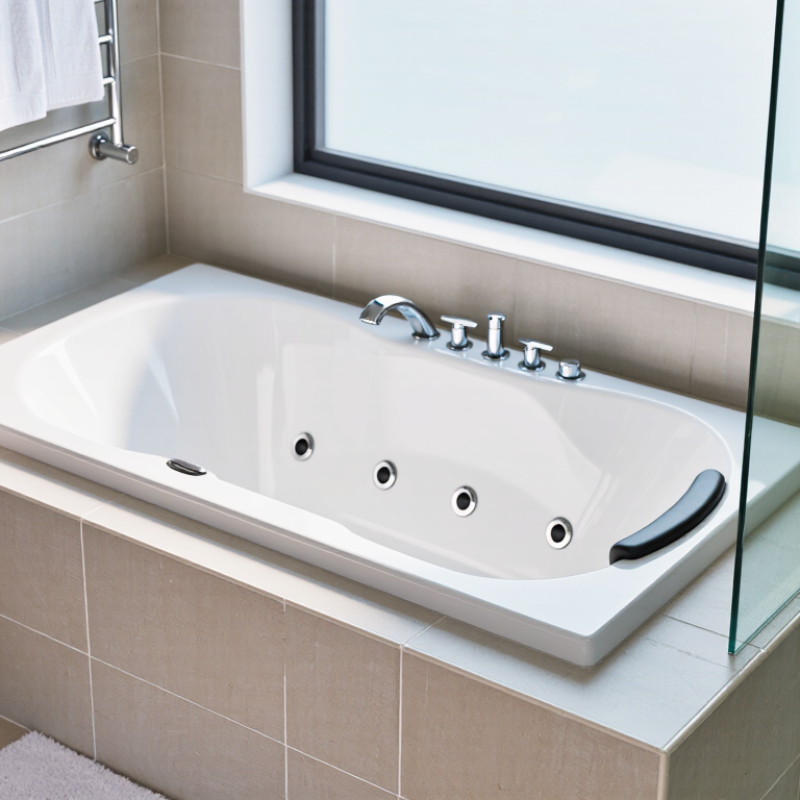
Understanding Small Jacuzzi Baths and Their Core Features
A small Jacuzzi bath combines a compact tub with water jets designed to circulate water around the body. Its smaller footprint can suit an ensuite or a narrow bathroom, but the internal bathing area still matters. Check the tub’s length, depth, and seating shape against the person who will use it. A model may fit the room yet feel cramped once filled.
Jet placement affects the bathing experience. Side jets may target the back or legs, while air jets create a gentler stream of bubbles. More jets do not automatically mean better comfort; their position and adjustable force matter. Some systems also need room for a pump, access panel, and electrical connections. Not a minor detail. Before choosing, measure doorways and check installation requirements with a qualified installer. Ask how the pump and plumbing can be reached for cleaning or repairs. A compact bath can still use substantial water, depending on its depth and shape. And, honestly, the balance between a smaller footprint and comfortable soaking is not always perfect. Read the care instructions, too; neglected jets can collect residue and need regular cleaning.
What Are the China Top 10 Small Jacuzzi Bath Brands? - Understanding Small Jacuzzi Baths and Their Core Features
Brand-neutral guide to compact whirlpool bath formats and features. The dimensions below are indicative planning examples, not product specifications or a ranking; actual sizes, capacities, and installation requirements vary by model.
| Compact bath format | Indicative footprint (L × W) | Common hydrotherapy feature | Space and installation considerations |
|---|---|---|---|
| Short rectangular bath | About 1,200–1,300 × 700 mm | Water jets or air jets, depending on the model | Useful where room length is limited; check internal bathing space as well as the outside dimensions. |
| Compact rectangular bath | About 1,300–1,400 × 700–750 mm | A small set of water or air outlets | Measure doorways and access routes before delivery; the pump may need a service access panel. |
| Short standard-width bath | About 1,400–1,500 × 700 mm | Water jets that circulate bath water | Confirm the floor can support the filled bath and occupant; filled weight depends on capacity and materials. |
| Compact double-ended bath | About 1,400–1,500 × 750 mm | Jet placement may be arranged at one or both ends | Check that the tap, controls, and jet positions do not interfere with the intended bathing posture. |
| Compact square corner bath | Around 1,200 × 1,200 mm | Water-jet or air-jet systems are available in some designs | Uses a corner footprint; account for the wider front edge and space needed for entry and cleaning. |
| Offset corner bath | Examples range from about 1,300 × 900 mm upward | Jet layout varies with the seat and basin shape | Check left- or right-hand orientation and the location of plumbing connections. |
| Compact deep-soaking format | Often planned within roughly 1,200–1,400 × 700–800 mm | Hydrotherapy jets may be offered, but are not included in every design | Compare usable water depth, step-over height, and overflow position; overall height alone does not indicate soaking depth. |
| Compact freestanding bath | Some designs are around 1,400–1,500 × 700–800 mm | Integrated systems depend on the specific bath design | Allow clearance around the bath for cleaning and installation; confirm how the pump and pipework are accessed. |
| Air-jet system in a compact bath | Depends on the bath shell; check the selected model’s dimensions | Blows air through small outlets to create bubbles | Ask about drying or purging the air channels and follow the manufacturer’s cleaning instructions. |
| Water-jet or combination system | Depends on the bath shell and the number of system components | Water jets circulate bath water; combination systems may include both water and air outlets | Check electrical requirements, pump access, noise information, and cleaning guidance before installation. |
Before purchase, verify the manufacturer’s technical drawing, usable internal dimensions, water capacity, electrical requirements, and required service clearances. “Jacuzzi” is commonly used informally for a whirlpool bath; this table does not identify or rank brands.